
Lessons are carefully structured to support understanding, memory, and confidence over time. Each session follows a consistent format so that students know what to expect and can focus fully on learning.
A typical one-hour GCSE Maths lesson structure:
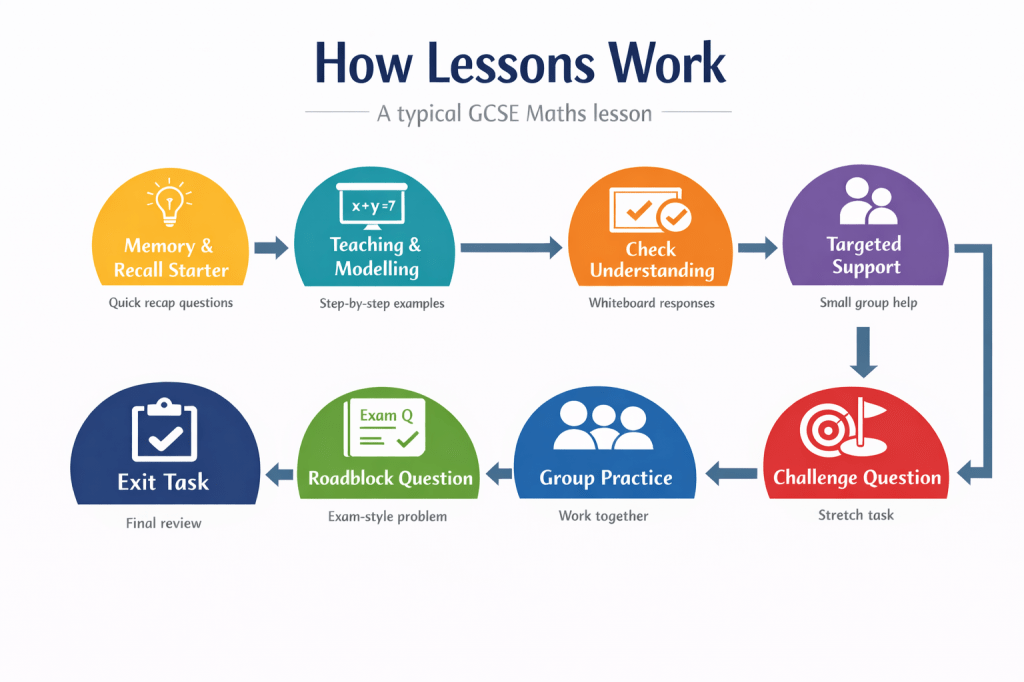
Classes run four times per week, with each lesson lasting one hour.
A typical lesson includes:
1. Memory & recall starter
Each lesson begins with a short retrieval task made up of four carefully chosen topics. These revisit high-frequency GCSE questions on a rotating basis, helping students strengthen long-term memory and combat forgetting.
This approach supports exam readiness without adding pressure.
2. Teaching and modelling
New content is introduced through clear explanation and worked examples. I model my thinking step-by-step so that students can understand how and why methods work — not just what they need to do.
3. Live checks for understanding
Students use whiteboards to respond to questions during the lesson. This allows me to check understanding in real time and address misconceptions immediately, rather than after the lesson has ended.
4. Targeted support and independent practice
Students who are confident with the material can then begin working independently on carefully selected tasks.
Students who need more support work with me, either individually or in a small breakout group, so misconceptions can be addressed calmly and thoroughly.
This ensures no one is left behind, while others continue to be appropriately challenged.
5. Exam-style ‘roadblock’ question
Midway through the lesson, students complete a GCSE exam-style question from a different topic. This deliberate revisiting helps strengthen recall and flexibility — key skills for exam success.
6. Guided practice and collaboration
We return to guided practice, followed by a group or paired task. Working together helps students develop mathematical language, reasoning skills, and confidence in explaining their thinking.
7. Challenge question
Each lesson includes an optional challenge question. Students can attempt this independently or collaboratively, providing stretch and aspiration in a low-pressure way.
8. Exit task
Lessons end with a short exit task to check understanding. This helps inform future teaching and ensures learning is secure before moving on.
Why this approach works
- Learning is spaced, revisited, and connected
- Teaching adapts in real time to student understanding
- Students are supported without feeling rushed or pressured
- Exam skills are built steadily alongside content knowledge
- Small groups allow every student to be known and supported
This structure is repeated consistently across the week so students build confidence through routine, clarity, and success.
A calm, focused learning environment
Classes are kept deliberately small, with a maximum of ten students, to allow meaningful interaction, thoughtful support, and a calm pace.
My aim is always to support steady progress over time, helping students feel secure in their learning and confident in their ability to succeed at GCSE Maths.
If you’re looking for GCSE Maths teaching that is structured, thoughtful, and designed to support real understanding, Miss Murray’s Mission offers a calm and supportive approach.
No obligation, just a friendly discussion to see if these classes are the right fit for your child.
 Maths with Miss Murray